
What GSM measures
GSM means grams per square meter: the mass of one square meter of fabric. It is the metric version of fabric weight, which in the US is often quoted in ounces per square yard. Textile labs measure it by cutting specimens of a known area and weighing them, following standard methods such as ASTM D3776.
Converting is simple arithmetic: one ounce per square yard equals about 33.9 g/m². So 410 GSM is roughly 12.1 oz/yd², which is why heavyweight 410 GSM fabric is often described as "about 12 oz."
Where 410 GSM sits
Brands use the bands loosely, but as a rough guide for knit sweatshirt fabric:
| Range | Typical description | What it usually feels like |
|---|---|---|
| Under ~250 GSM | Lightweight | Thin, layer-friendly, drapes softly, can look limp |
| ~250–350 GSM | Midweight | The common retail sweatshirt range |
| ~350 GSM and up | Heavyweight | Dense hand, holds its shape, noticeably warmer |
At 410 GSM, a garment sits clearly in heavyweight territory.
What French Terry is
French Terry is a knit fabric with a smooth face and a looped back. Unlike fleece, those loops are left intact rather than brushed into fluff. The loops trap some air for warmth, and because they are not brushed the fabric tends to shed and pill less than brushed fleece. It also breathes a little better, which makes it a sensible choice for a climate like South Florida's as well as for colder places.
Why heavyweight matters
- Structure: denser fabric holds a shape. Necklines, hoods and cuffs sit where they were cut rather than collapsing.
- Drape and opacity: heavier knits hang straighter and are less see-through.
- Warmth: more fiber per square meter generally means more insulation.
- Durability: more material gives more to wear through, though yarn quality and construction matter just as much.
What GSM does not tell you
GSM is only weight. It does not tell you fiber quality, yarn twist, knit density, dye quality or how well the garment is sewn. A badly made heavy garment is still badly made. Read GSM alongside fiber content, finishing (for example, whether the fabric is pre-shrunk) and construction. Our guide to telling a premium hoodie from a cheap one covers those.
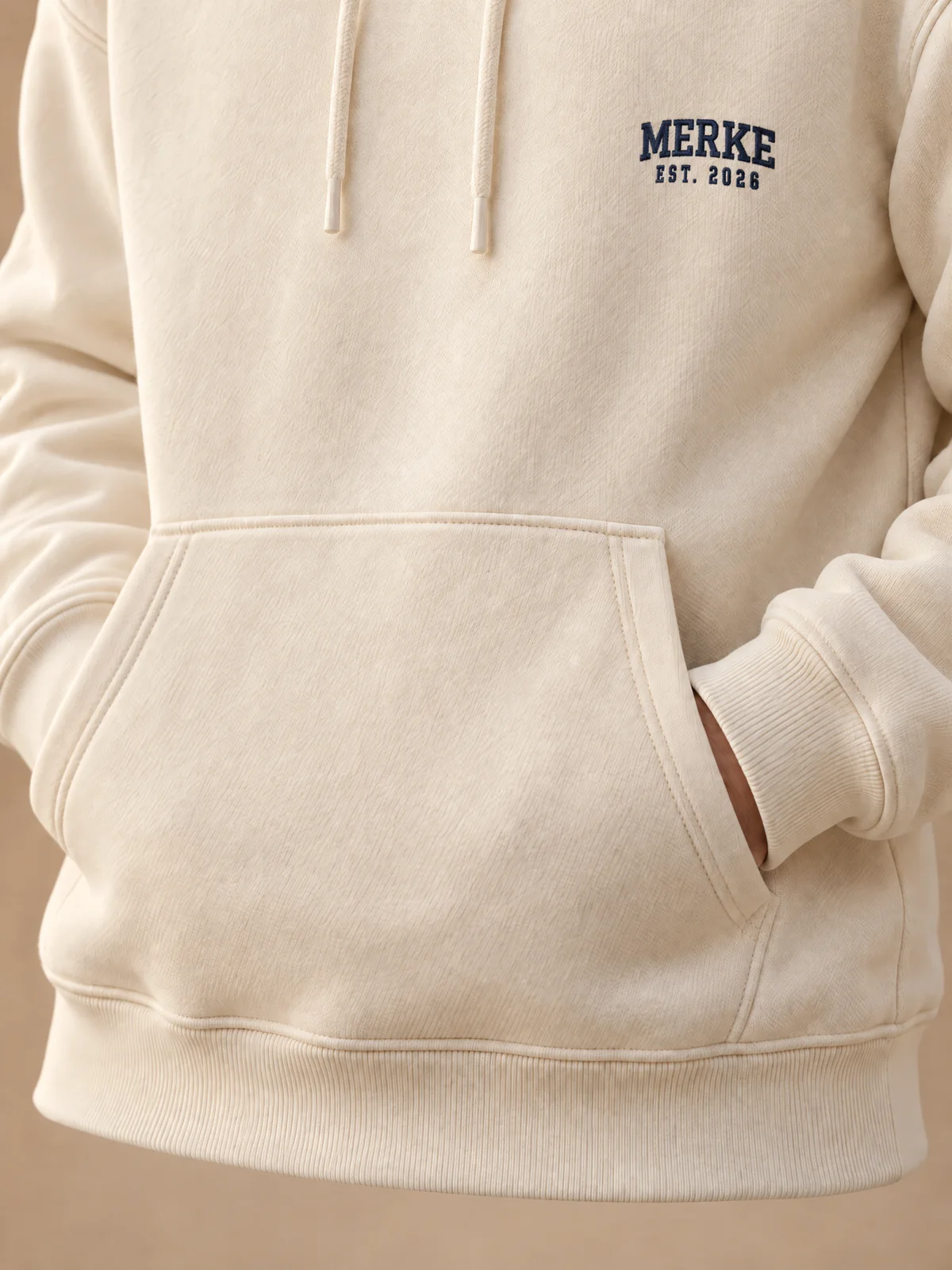
The MERKE ED001 Founder Collection is a matching-number cream set: the Embroidered Twill Cap, The Original mockneck and The Hoodie, with the mockneck and hoodie in 100% cotton 410 GSM French Terry. Only 500 Founder sets — $199 for all three pieces ($384 if bought separately), with 15% off all future MERKE products for life (until Edition 001 leaves production in mid-December). Numbered #0001–0500 and made once. Individual pieces are numbered #0501–2500: The Original mockneck $148 and The Hoodie $178, each with a free cap while the first 1,000 free caps last. Made to order, numbered, ships Q1 2027. Free US shipping on the Founder set. 14-day returns after delivery.
VIEW THE FOUNDER COLLECTION Read more on merkeusa.comFAQ
What does 410 GSM mean?
410 grams per square meter of fabric, roughly 12.1 ounces per square yard. It is a heavyweight fabric for sweatshirts and hoodies.
Is 410 GSM good for a hoodie?
It is a heavyweight choice: structured, opaque and warm. Whether it suits you depends on whether you want a dense, shape-holding garment or a lighter layer.
Is French Terry the same as fleece?
No. Both are knits with a looped back, but fleece has those loops brushed into a soft pile. French Terry keeps the loops intact, so it is usually more breathable and tends to pill less.
Is a higher GSM always better?
No. GSM only measures weight. Fiber quality, knit and construction decide whether a garment lasts and fits well.
Sources
- Wikipedia: Grammage (mass per unit area)
- ASTM D3776: Standard Test Methods for Mass Per Unit Area (Weight) of Fabric
- Wikipedia: French terry
More from the Journal
- How to Tell a Premium Heavyweight Cotton Hoodie from a Cheap One
- Limited-Edition Numbered Hoodies and Streetwear, Explained
- How to Style a Mockneck: 7 Outfits from Casual to Dressed-Up
- How to Wash and Care for Heavyweight Cotton Hoodies and Sweatshirts
- 100% Cotton vs. Cotton-Poly Blend Hoodies: Which Should You Buy?
- French Terry vs Fleece Hoodies: What's the Difference (and Which Should You Buy?)
- What Is a Half or Short Turtleneck Called?
- How Made-to-Order Clothing Pre-Orders Work (and Your Rights as a Buyer)
- Embroidery vs. Screen Printing vs. Chenille: How Logos Go on Clothes
- Heavyweight Mockneck Sweatshirt: What to Look For Before You Buy
- Hoodie vs. Sweatshirt: What’s the Difference (and Which Should You Buy?)
- How to Measure a Hoodie and Choose the Right Size (Oversized Fit Guide)
- Dad Cap vs Fitted Cap vs Snapback: Baseball Cap Styles Explained
- Mock Neck, Funnel Neck, Polo Neck and Roll Neck: How to Tell Them Apart