
The short answer
Choose 100% cotton if you care most about a natural, dry hand-feel, breathability and a garment that ages softly. Choose a cotton-poly blend if you care most about low shrinkage, quick drying, wrinkle resistance and a lower price. The fiber label tells you which one you are holding.
What each fiber is
Cotton is a natural fiber made mostly of cellulose, grown around the seeds of the cotton plant. It absorbs moisture readily, which is a large part of why it feels breathable and comfortable against skin.
Polyester is a synthetic polymer, most commonly polyethylene terephthalate (PET), the same family of plastic used in drink bottles. It is hydrophobic, meaning it resists absorbing water, and it has high strength and minimal shrinkage. Polyester is often blended with cotton to combine properties of both: cotton-polyester blends can be strong, wrinkle- and tear-resistant, and shrink less.
Side-by-side
| Trait | 100% cotton | Cotton-poly blend |
|---|---|---|
| Hand-feel | Dry, matte, natural; softens with washing | Smoother, sometimes slightly slick; feel depends on the blend ratio |
| Moisture | Absorbs sweat; feels breathable but dries slower | Absorbs less; dries faster, can feel clammy when you overheat |
| Shrinkage | Can shrink with heat unless pre-shrunk; wash cold | Generally shrinks less, because polyester has minimal shrinkage |
| Wrinkles | Wrinkles more | Resists wrinkling |
| Pilling | Pills can form but tend to break off | Strong polyester fibers can hold pills on the surface |
| Stains | Water-based stains soak in; oily stains wash out more readily | Resists water-based stains; oily stains can cling to polyester |
| Heat | Chars rather than melts | Polyester can melt when ignited, so keep it away from open flame |
| Microfibers | Sheds natural fibers | Sheds synthetic microfibers in the wash (see below) |
| Price | Usually higher at the same weight | Usually lower |
What the research says about shedding in the wash
A University of Plymouth study (Napper and Thompson, 2016) washed synthetic fabrics in domestic machines under different conditions. It estimated that an average 6 kg wash could release about 137,951 fibers from polyester-cotton blend fabric, 496,030 from polyester and 728,789 from acrylic. Those synthetic fibers add to microplastic pollution. If that matters to you, it is a point in favor of all-cotton garments, or at least of washing synthetics less often and on cooler, shorter cycles.
How blend ratio changes things
- 80/20 cotton/poly: feels mostly like cotton, with a little extra shape-holding and less shrinkage. Common in retail fleece.
- 50/50: a true middle ground. Lighter, quicker-drying and more wrinkle-resistant, with a noticeably more synthetic feel.
- Tri-blends (cotton, polyester and rayon): very soft and drapey, usually lighter weight, and more prone to looking worn.
How to read the label
In the US, the Textile Fiber Products Identification Act and the FTC's rules under it require clothing labels to list fiber content by generic name and percentage by weight, along with the country of origin and the manufacturer or dealer identity. So "Cotton blend" on a product page is not enough. Look for the actual percentages on the label or spec sheet. For a full quality check beyond fiber, see how to tell a premium hoodie from a cheap one.
Weight matters as much as fiber
A thin 100% cotton hoodie and a heavy one are very different garments. Fabric weight (GSM) drives structure, warmth and drape. Our guide to what 410 GSM French Terry means explains how to read it.
Why MERKE uses 100% cotton
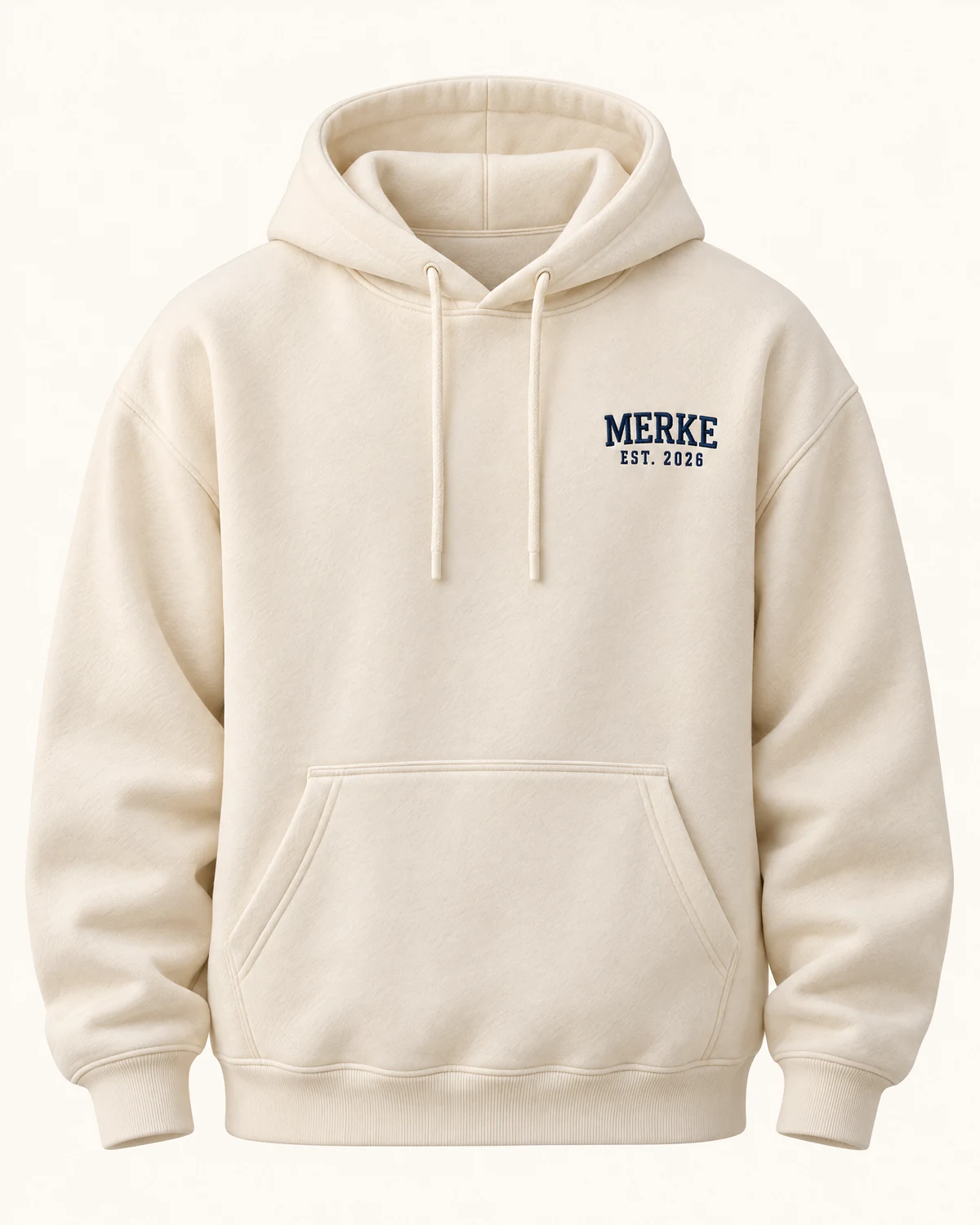
We chose 100% cotton French Terry at 410 GSM for The Original mockneck and The Hoodie because we wanted a dense, dry, natural feel and a garment that softens with wear rather than one built around low cost or quick drying. The trade-off is that cotton needs a little care: wash cold and dry low or flat. Our heavyweight cotton care guide covers it.
The MERKE ED001 Founder Collection is a matching-number cream set: the Embroidered Twill Cap, The Original mockneck and The Hoodie, with the mockneck and hoodie in 100% cotton 410 GSM French Terry. Only 500 Founder sets — $199 for all three pieces ($384 if bought separately), with 15% off all future MERKE products for life (until Edition 001 leaves production in mid-December). Numbered #0001–0500 and made once. Individual pieces are numbered #0501–2500: The Original mockneck $148 and The Hoodie $178, each with a free cap while the first 1,000 free caps last. Made to order, numbered, ships Q1 2027. Free US shipping on the Founder set. 14-day returns after delivery.
VIEW THE FOUNDER COLLECTION Read more on merkeusa.comFAQ
Is a 100% cotton hoodie better than a blend?
Not universally. 100% cotton feels more natural and breathable and ages softly; a cotton-poly blend shrinks less, dries faster and usually costs less. Pick based on which traits you care about.
Do cotton-polyester hoodies shrink?
They generally shrink less than all-cotton hoodies, because polyester has minimal shrinkage. Washing cold and drying low still helps.
Why do polyester blend hoodies pill?
Polyester fibers are strong, so when fibers tangle into small balls on the surface, the balls tend to stay attached instead of breaking off.
Do polyester hoodies shed microplastics?
Yes. A 2016 University of Plymouth study found that washing polyester and polyester-cotton blend fabrics releases synthetic microfibers, with pure polyester shedding more than the blend.
What fabric is the MERKE hoodie?
The MERKE ED001 Hoodie and The Original mockneck are 100% cotton French Terry at 410 GSM.
Sources
- Wikipedia: Cotton
- Wikipedia: Polyester
- Napper & Thompson (2016), Release of synthetic microplastic plastic fibres from domestic washing machines, Marine Pollution Bulletin 112
- eCFR: 16 CFR Part 303, Rules under the Textile Fiber Products Identification Act
- FTC: Clothing and Textiles business guidance
More from the Journal
- What 410 GSM French Terry Means (About 12 oz)
- How to Tell a Premium Heavyweight Cotton Hoodie from a Cheap One
- Limited-Edition Numbered Hoodies and Streetwear, Explained
- How to Style a Mockneck: 7 Outfits from Casual to Dressed-Up
- How to Wash and Care for Heavyweight Cotton Hoodies and Sweatshirts
- French Terry vs Fleece Hoodies: What's the Difference (and Which Should You Buy?)
- What Is a Half or Short Turtleneck Called?
- How Made-to-Order Clothing Pre-Orders Work (and Your Rights as a Buyer)
- Embroidery vs. Screen Printing vs. Chenille: How Logos Go on Clothes
- Heavyweight Mockneck Sweatshirt: What to Look For Before You Buy
- Hoodie vs. Sweatshirt: What’s the Difference (and Which Should You Buy?)
- How to Measure a Hoodie and Choose the Right Size (Oversized Fit Guide)
- Dad Cap vs Fitted Cap vs Snapback: Baseball Cap Styles Explained
- Mock Neck, Funnel Neck, Polo Neck and Roll Neck: How to Tell Them Apart