
The short answer
Printing methods (screen printing, direct-to-garment and heat transfer vinyl) put ink or film on the surface of the fabric. Thread-based methods (embroidery, appliqué and chenille) stitch the design into or onto the garment. Prints are flat and can carry fine detail and many colors; stitched decoration is raised, textured and generally the more premium-looking finish on heavyweight knits.
The methods at a glance
| Method | How it works | Look and feel | Best for |
|---|---|---|---|
| Screen printing | Ink is pushed through a mesh screen with a stencil; one color per screen | Flat layer of ink on the surface; plastisol ink sits on top, water-based ink soaks in and feels softer | Bold graphics, larger runs |
| Direct-to-garment (DTG) | An inkjet printer jets water-based ink onto a pretreated garment | Soft, thin print; can reproduce photos and gradients | Full-color art, small runs, cotton |
| Heat transfer vinyl (HTV) | A cut film of PU or PVC is pressed on with heat | Smooth, slightly plastic film sitting on the fabric | Names, numbers, one-offs |
| Embroidery | A computer-controlled machine stitches a digitized design in thread | Raised, textured, with a slight sheen from the thread | Chest logos, caps, small marks |
| Appliqué | Shaped pieces of fabric (such as felt or twill) are sewn onto the garment | Layered, dimensional, clean edges | Large letters and shapes |
| Chenille | Looped, fuzzy yarn stitched into a raised pile | Soft, deep texture, the classic varsity-letter look | Statement logos, varsity styling |
Screen printing
Screen printing uses a mesh with a blocking stencil. A squeegee pulls ink across the screen so it passes through the open areas onto the fabric. Each color needs its own screen, which is why it suits designs with a limited palette and larger quantities. The two common ink families feel different: plastisol is a PVC-based ink that is cured with heat and sits on top of the fabric, while water-based inks penetrate the fibers for a softer hand.
Direct-to-garment (DTG)
DTG is essentially inkjet printing for clothing. The garment is usually pretreated, held flat on a platen and printed with water-based textile ink, which works best on natural fibers such as cotton. It handles photographic detail and gradients that would need many screens, and it has little setup, so it is common for print-on-demand.
Heat transfer vinyl (HTV)
HTV is a plastic film, typically polyurethane or PVC, cut into the design by a plotter, "weeded" by hand to remove excess material, and applied with a heat press. It is the usual method for player names and numbers on jerseys and for single custom pieces.
Embroidery
Modern embroidery is done on computer-controlled machines that follow a digitized file. The design is built from stitch types such as running stitch for outlines, satin stitch for lettering and narrow shapes, and fill (tatami) stitch for larger areas. Because it is thread sewn through the fabric, embroidery adds texture and holds its shape, which is why it is the standard for cap fronts and chest logos. Very fine detail and tiny text are harder in thread than in ink.
Appliqué and chenille
Appliqué sews shaped pieces of fabric onto a garment, so a large letter can be cut from felt or twill and stitched down rather than filled entirely with thread. Chenille, from the French word for caterpillar, is a fuzzy yarn; stitched as raised loops it creates the deep pile associated with letter jackets and varsity letters. Combining chenille, felt appliqué and embroidery produces a layered, dimensional mark that flat printing cannot reproduce.
How to tell which method was used
- Look inside. Embroidery and appliqué usually show stitching or a backing on the reverse side. A print leaves the inside plain.
- Run a finger over it. Thread and chenille are raised and textured. Plastisol feels like a smooth coating; DTG and water-based prints feel close to the fabric.
- Check the edges. Appliqué has a stitched border around a fabric piece. HTV has a clean film edge.
- Read the product description. Good listings name the method, not just "logo."
Caring for decorated garments
Follow the care label first; the FTC Care Labeling Rule requires apparel to carry regular care instructions. In general, washing inside out in cold water and drying on low or flat reduces abrasion on embroidery and prints, and you should avoid ironing directly on a print or vinyl. More in our guide to caring for heavyweight cotton.
How MERKE decorates ED001
MERKE's first release uses thread, not ink, for its marks:
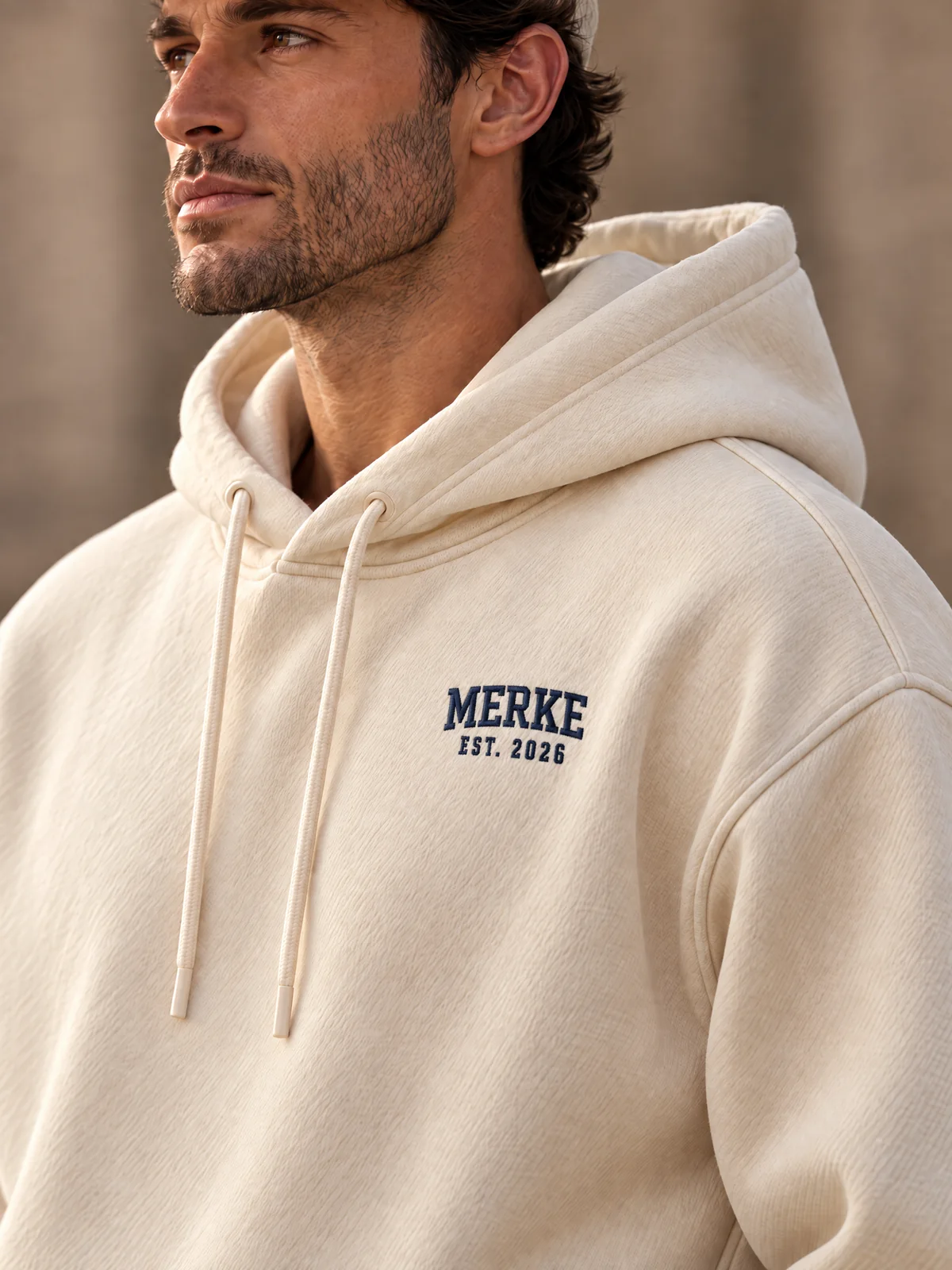
- The Hoodie: MERKE / EST. 2026 embroidery at the upper-left chest and a large dimensional MERKE varsity treatment across the upper back, built from chenille and felt appliqué with embroidery. $178, numbered #0501–2500, with a free numbered cap while the first 1,000 free caps last.
- The Original: the mockneck in the same 410 GSM 100% cotton French Terry. $148, with a free numbered cap while the first 1,000 free caps last.
- The Embroidered Twill Cap: ivory cotton twill with deep-navy MERKE / EST. 2026 embroidery on the front and the edition number embroidered at the rear. $58 on its own.
- Founder sets #0001–0500: all three pieces with one matching number for $199 ($384 if bought separately), with 15% off all future MERKE products for life (until Edition 001 leaves production in mid-December). Made to order, numbered, ships Q1 2027.
See what 410 GSM French Terry means and how to tell a premium hoodie from a cheap one.
The MERKE ED001 Founder Collection is a matching-number cream set: the Embroidered Twill Cap, The Original mockneck and The Hoodie, with the mockneck and hoodie in 100% cotton 410 GSM French Terry. Only 500 Founder sets — $199 for all three pieces ($384 if bought separately), with 15% off all future MERKE products for life (until Edition 001 leaves production in mid-December). Numbered #0001–0500 and made once. Individual pieces are numbered #0501–2500: The Original mockneck $148 and The Hoodie $178, each with a free cap while the first 1,000 free caps last. Made to order, numbered, ships Q1 2027. Free US shipping on the Founder set. 14-day returns after delivery.
VIEW THE FOUNDER COLLECTION Read more on merkeusa.comFAQ
Is embroidery better than screen printing?
Neither is better for everything. Embroidery is raised and textured and suits logos, caps and heavyweight knits; screen printing is flat and suits bold, larger graphics with a limited number of colors.
What is the difference between screen printing and DTG?
Screen printing pushes ink through a stenciled mesh, one screen per color. DTG jets water-based ink directly onto a pretreated garment with an inkjet printer, which handles photos and gradients with little setup.
What is chenille on a hoodie?
Chenille is a fuzzy yarn (the name is French for caterpillar) stitched into raised loops. It gives the deep, soft texture of classic varsity letters.
What is appliqué on clothing?
Appliqué is a piece of fabric, such as felt or twill, cut to shape and sewn onto the garment, often for large letters or shapes.
How can I tell if a logo is embroidered or printed?
Turn the garment inside out. Embroidery shows stitching or a backing behind the design; a print leaves the inside plain. Embroidery also feels raised and textured.
How is the MERKE ED001 Hoodie decorated?
It has MERKE / EST. 2026 embroidery at the upper-left chest and a large dimensional MERKE varsity treatment on the upper back made with chenille and felt appliqué with embroidery.
Sources
- Wikipedia: Machine embroidery
- Wikipedia: Screen printing
- Wikipedia: Plastisol
- Wikipedia: Direct-to-garment printing
- Wikipedia: Heat transfer vinyl
- Wikipedia: Appliqué
- Wikipedia: Chenille fabric
- Wikipedia: Letterman (sports)
- eCFR: 16 CFR Part 423, Care Labeling of Textile Wearing Apparel
More from the Journal
- What 410 GSM French Terry Means (About 12 oz)
- How to Tell a Premium Heavyweight Cotton Hoodie from a Cheap One
- Limited-Edition Numbered Hoodies and Streetwear, Explained
- How to Style a Mockneck: 7 Outfits from Casual to Dressed-Up
- How to Wash and Care for Heavyweight Cotton Hoodies and Sweatshirts
- 100% Cotton vs. Cotton-Poly Blend Hoodies: Which Should You Buy?
- French Terry vs Fleece Hoodies: What's the Difference (and Which Should You Buy?)
- What Is a Half or Short Turtleneck Called?
- How Made-to-Order Clothing Pre-Orders Work (and Your Rights as a Buyer)
- Heavyweight Mockneck Sweatshirt: What to Look For Before You Buy
- Hoodie vs. Sweatshirt: What’s the Difference (and Which Should You Buy?)
- How to Measure a Hoodie and Choose the Right Size (Oversized Fit Guide)
- Dad Cap vs Fitted Cap vs Snapback: Baseball Cap Styles Explained
- Mock Neck, Funnel Neck, Polo Neck and Roll Neck: How to Tell Them Apart