
The short answer
Lay a hoodie that fits you the way you like flat on a table, measure chest width (armpit to armpit), body length and sleeve length, and compare those three numbers to the brand's garment size chart. Pick the size whose numbers are closest to your reference piece, giving chest width the most weight. Letter sizes alone are not a reliable guide, because brands do not size consistently.
Why letter sizes are not enough
Clothing labels follow three broad approaches: body dimensions (the body the garment was designed for), product dimensions (the measurements of the garment itself), and ad hoc codes like S, M or XL that have no fixed relationship to any measurement. Most tops, hoodies included, are sold with ad hoc letter sizes. Standards for body measurement exist, such as ISO 8559-1 and the European EN 13402, but adoption varies and many brands set their own grading. Over time, sizes have also drifted larger for the same label, a pattern known as vanity sizing. The practical result: your Medium at one brand can be another brand's Large.
Body measurements vs. garment measurements
A size chart can list either one, and mixing them up is the most common sizing mistake.
| Body measurement | Garment measurement | |
|---|---|---|
| What it measures | You: chest circumference, arm length | The piece laid flat: chest width, length, sleeve |
| Typical chest number | A circumference around the body | A flat width across the front, roughly half the garment's circumference |
| How to use it | Measure yourself and the brand adds its own ease | Measure a hoodie you own and compare directly |
If a chart says "chest width" or "pit to pit", it is almost always a flat garment measurement. Doubling it gives the approximate circumference of the garment, which should be larger than your body's chest circumference; the difference is the ease, or room, that makes a fit relaxed or oversized.
How to measure a hoodie you already own
- Pick your reference. Choose a hoodie or sweatshirt whose fit you like, ideally in a similar fabric weight, since heavier knits drape differently from thin ones.
- Lay it flat. Put it face up on a table, zip or smooth the front, and flatten wrinkles without stretching the fabric.
- Chest width. Measure straight across the front from one armpit seam to the other, about 1 inch below the armpit.
- Body length. Measure from the highest point of the shoulder, where it meets the collar or hood, straight down to the bottom of the hem or rib.
- Sleeve length. Measure from the shoulder seam along the top of the sleeve to the end of the cuff. Some brands measure from the center back of the neck instead, so check how the chart defines it.
- Write it down in inches and compare it with the chart, measurement by measurement.
Reading the chart: which number matters most
- Chest width decides the overall fit. Within about 1 inch of your reference piece usually feels the same; 2 inches or more is a noticeable change.
- Length decides the proportion. Oversized hoodies are often wider without being much longer, so a longer length is the clue that a size is simply bigger, not just cut boxier.
- Sleeve matters if you have long arms or like the cuff to sit at the wrist. Ribbed cuffs can be pushed up, so a slightly long sleeve is easier to live with than a short one.
Between two sizes? Size down for a cleaner look under a jacket, size up if you want the drop-shoulder, roomy oversized silhouette.
Does a cotton hoodie shrink?
Shrinkage happens when a fabric relaxes stresses built in during spinning, knitting and finishing, usually the first time it is washed in water, especially hot water. Fabrics that are pre-shrunk have been treated to reduce that residual shrinkage before cutting, so the size you measure is closer to the size you keep. Even so, follow the care label: washing cold and skipping high dryer heat helps any cotton piece keep its measurements. If a chart does not say a garment is pre-shrunk, leave a little room.
Example: the MERKE size chart
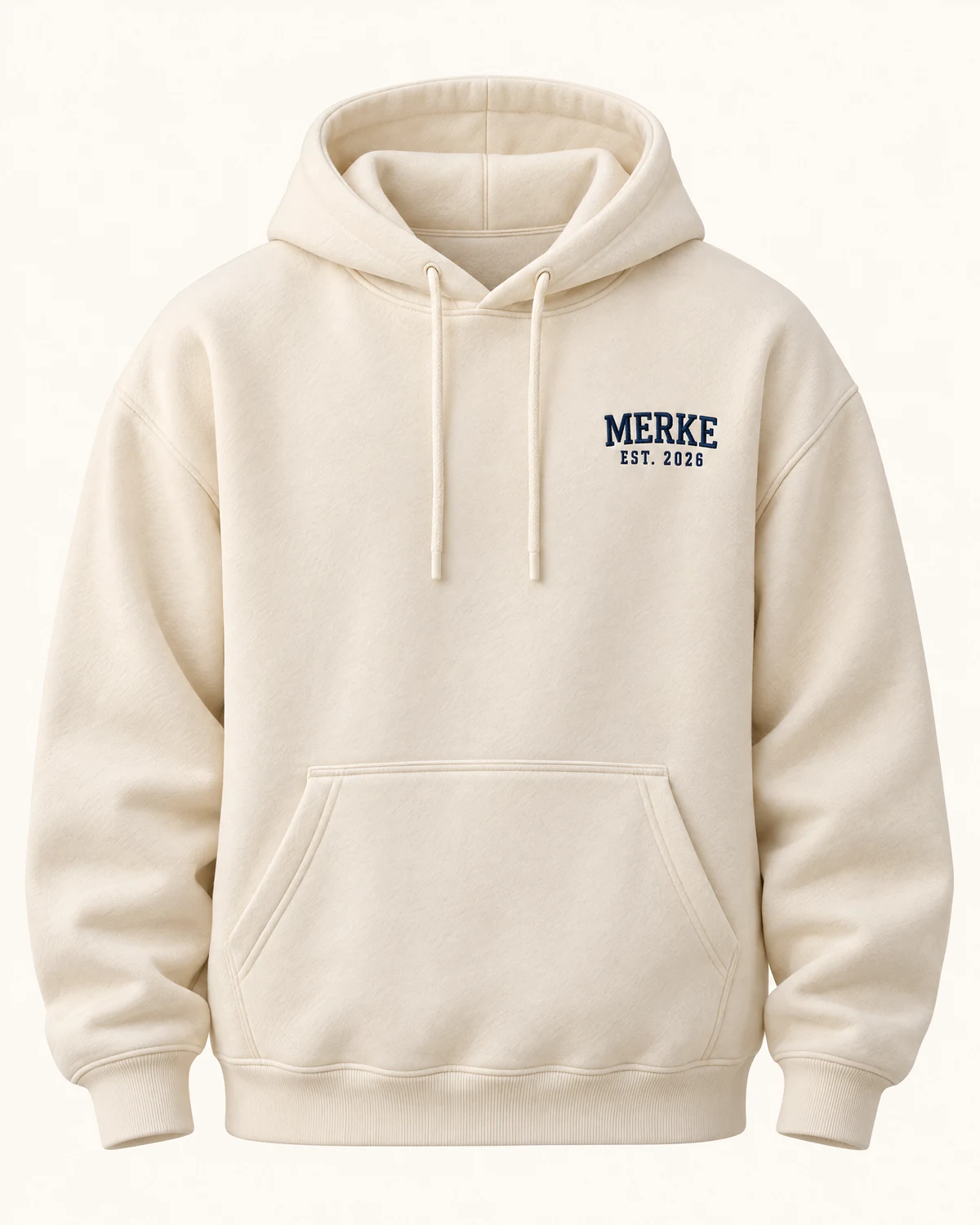
MERKE publishes garment measurements for The Original mockneck and The Hoodie, which share the same relaxed, oversized unisex fit and are cut from 410 GSM, 100% cotton French Terry, pre-shrunk for a consistent fit. Sizes are paired, so there are three instead of six:
| Size | Chest width | Length | Sleeve length |
|---|---|---|---|
| S/M | 24.5 in | 25 in | 24.7 in |
| L/XL | 28.5 in | 27 in | 25.7 in |
| XXL | 31 in | 28.5 in | 26 in |
To use it, measure your reference hoodie's chest width and length and find the closest row. Because the fit is oversized, someone who wears a regular-fit M or L elsewhere should compare numbers carefully rather than assuming a letter. The Embroidered Twill Cap is one size fits all.
Quick checklist before you order
- Measure a hoodie you already like, flat, in inches.
- Confirm whether the chart is body or garment measurements.
- Match chest width first, then length, then sleeve.
- Check whether the fabric is pre-shrunk and how it should be washed.
- Read the return policy so you know your options if the fit is off.
The MERKE ED001 Founder Collection is a matching-number cream set: the Embroidered Twill Cap, The Original mockneck and The Hoodie, with the mockneck and hoodie in 100% cotton 410 GSM French Terry. Only 500 Founder sets — $199 for all three pieces ($384 if bought separately), with 15% off all future MERKE products for life (until Edition 001 leaves production in mid-December). Numbered #0001–0500 and made once. Individual pieces are numbered #0501–2500: The Original mockneck $148 and The Hoodie $178, each with a free cap while the first 1,000 free caps last. Made to order, numbered, ships Q1 2027. Free US shipping on the Founder set. 14-day returns after delivery.
VIEW THE FOUNDER COLLECTION Read more on merkeusa.comFAQ
How do you measure a hoodie chest size?
Lay the hoodie flat and measure straight across the front from one armpit seam to the other, about 1 inch below the armpit. That is the flat chest width; doubling it gives the approximate circumference of the garment.
Is pit to pit the same as chest size?
No. Pit to pit is a flat garment measurement across the front. Body chest size is a circumference around you. A garment that fits has a circumference larger than your body chest; the difference is the ease.
Should I size up for an oversized hoodie?
Only if the brand cuts a regular fit and you want it roomier. If the hoodie is already designed as oversized, start with your usual measurements and compare the chart to a hoodie you own before sizing up.
Will a 100% cotton hoodie shrink?
Cotton can shrink in hot water or high dryer heat. Pre-shrunk fabric reduces that residual shrinkage, and washing cold and avoiding high heat helps a piece keep its measurements.
What sizes does MERKE offer?
The Original mockneck and The Hoodie come in S/M (24.5 in chest width, 25 in length), L/XL (28.5 in, 27 in) and XXL (31 in, 28.5 in) in a relaxed oversized unisex fit. The Embroidered Twill Cap is one size fits all.
Sources
- Wikipedia: Clothing sizes
- Wikipedia: Vanity sizing
- ISO 8559-1:2017, Size designation of clothes: Anthropometric definitions for body measurement
- Wikipedia: EN 13402 (European size designation of clothes)
- Wikipedia: Dimensional stability (fabric)
More from the Journal
- What 410 GSM French Terry Means (About 12 oz)
- How to Tell a Premium Heavyweight Cotton Hoodie from a Cheap One
- Limited-Edition Numbered Hoodies and Streetwear, Explained
- How to Style a Mockneck: 7 Outfits from Casual to Dressed-Up
- How to Wash and Care for Heavyweight Cotton Hoodies and Sweatshirts
- 100% Cotton vs. Cotton-Poly Blend Hoodies: Which Should You Buy?
- French Terry vs Fleece Hoodies: What's the Difference (and Which Should You Buy?)
- What Is a Half or Short Turtleneck Called?
- How Made-to-Order Clothing Pre-Orders Work (and Your Rights as a Buyer)
- Embroidery vs. Screen Printing vs. Chenille: How Logos Go on Clothes
- Heavyweight Mockneck Sweatshirt: What to Look For Before You Buy
- Hoodie vs. Sweatshirt: What’s the Difference (and Which Should You Buy?)
- Dad Cap vs Fitted Cap vs Snapback: Baseball Cap Styles Explained
- Mock Neck, Funnel Neck, Polo Neck and Roll Neck: How to Tell Them Apart