
The short answer
Choose French terry if you want a cleaner loopback interior, more breathability and a fabric that tends to pill less. Choose fleece (fleece-back) if you want the classic soft, fuzzy inside and more warmth at a similar weight. Neither is automatically "premium." Yarn quality, weight and construction matter more than the name on the hangtag.
How each is made
Both fabrics are knits with a smooth face and loops on the reverse. French terry (sometimes called loopback) leaves those loops intact. Fleece-back takes the same kind of looped knit and brushes or naps the inside until the yarn becomes a soft pile. Gear Patrol describes French terry as a flat face with loops underneath that absorb moisture, and fleece-back as the version where the underside is brushed with sandpaper or wire brushes until it feels velvety.
Mills sometimes label constructions as two-thread (often terry) and three-thread (often the denser base used for fleece). The decisive difference for the buyer is still finishing: loops left alone versus loops raised into nap.
Side-by-side
| Trait | French terry | Fleece (fleece-back) |
|---|---|---|
| Inside face | Visible intact loops | Soft raised nap |
| Warmth | Moderate; air moves through the loops | Higher; the nap traps more still air |
| Breathability | Generally better | Lower, by design, for insulation |
| Hand-feel | Structured, slightly textured inside | Softer, fuller, "classic sweatshirt" inside |
| Pilling risk | Usually lower; loops stay more stable | Usually higher; raised fibers abrade more easily |
| Best seasons | Transitional and year-round climates | Cooler weather and warmth-first wear |
Trade explainers such as Voyager Textile put the same contrast in sourcing language: terry is lighter and more breathable with a clean loop structure; brushed fleece is warmer and softer, at the cost of a surface that can pill more.
How to check in-store or online
- Turn the garment inside out. Intact, even loops mean French terry (loopback). A soft, fuzzy pile means fleece-back.
- Read the product page. Look for "French terry," "loopback," "fleece" or "brushed." If the brand only says "sweatshirt fabric," ask or keep looking.
- Check fiber and weight. 100% cotton and cotton-poly blends behave differently, and GSM (or oz/yd²) tells you density. See what 410 GSM French Terry means and 100% cotton vs. cotton-poly blend hoodies.
- Feel recovery at the cuff. Quality rib should snap back. Soft fabric with floppy ribbing still wears poorly.
Why MERKE chose French Terry
MERKE is based in Delray Beach, Florida. We wanted a heavyweight garment that still works year-round in a warm, humid climate, not only in deep winter. French Terry at 410 GSM gives structure and opacity without the extra insulation of a brushed pile, and the unbrushed loopback interior tends to age more cleanly than fleece that pills where it rubs.
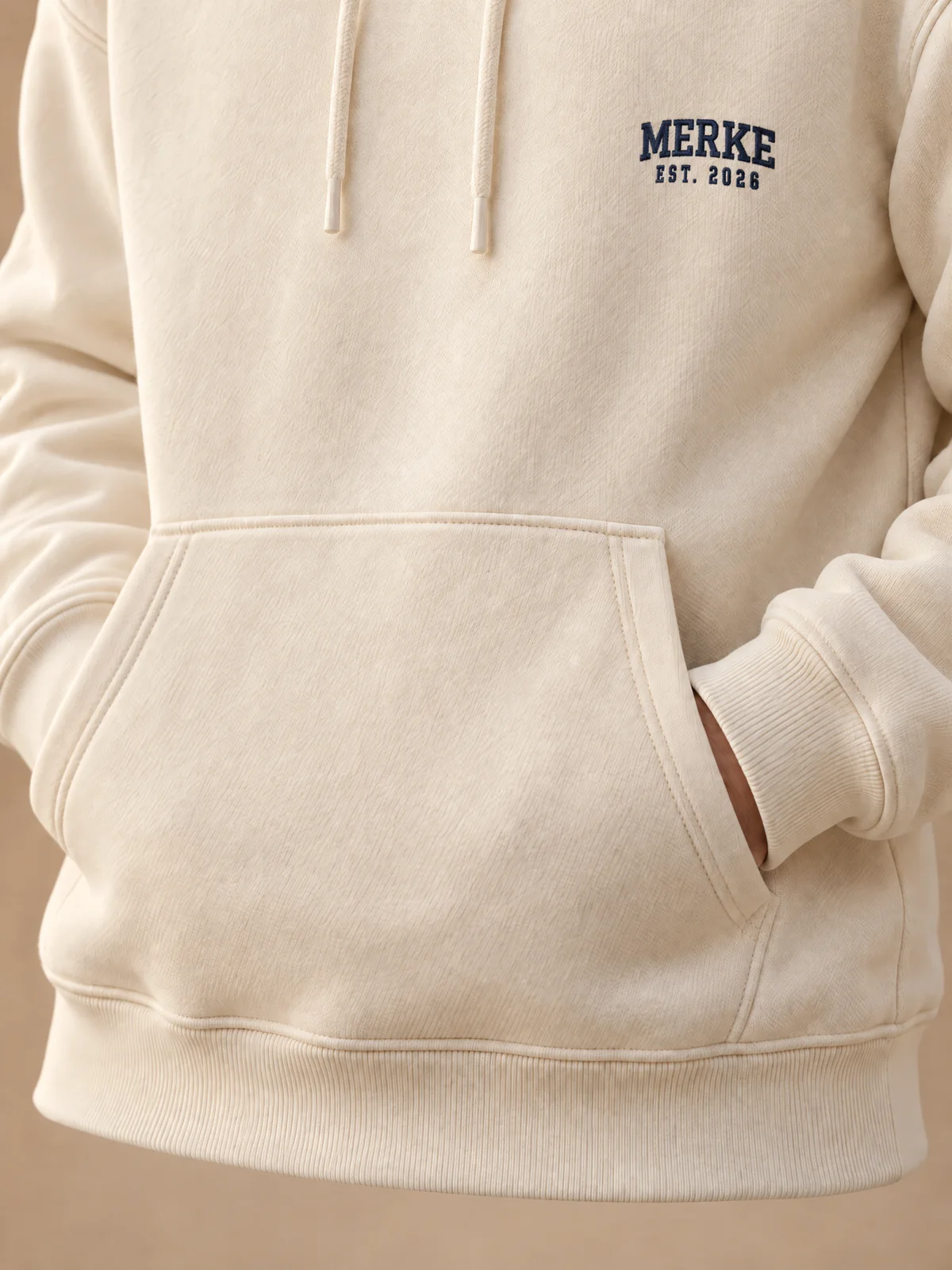
The Original mockneck and The Hoodie in Collection ED001 are 100% cotton French Terry at 410 GSM, with a loopback interior, pre-shrunk. That is a deliberate choice for hand, breathability and longevity, not a cheaper substitute for fleece.
The MERKE ED001 Founder Collection is a matching-number cream set: the Embroidered Twill Cap, The Original mockneck and The Hoodie, with the mockneck and hoodie in 100% cotton 410 GSM French Terry. Only 500 Founder sets — $199 for all three pieces ($384 if bought separately), with 15% off all future MERKE products for life (until Edition 001 leaves production in mid-December). Numbered #0001–0500 and made once. Individual pieces are numbered #0501–2500: The Original mockneck $148 and The Hoodie $178, each with a free cap while the first 1,000 free caps last. Made to order, numbered, ships Q1 2027. Free US shipping on the Founder set. 14-day returns after delivery.
VIEW THE FOUNDER COLLECTION Read more on merkeusa.comFAQ
Is French terry the same as fleece?
No. Both are knits with a looped back, but fleece has those loops brushed into a soft pile. French terry keeps the loops intact.
Is French terry warmer than fleece?
Usually not at a similar weight. Fleece's raised nap traps more air, so it tends to feel warmer. French terry is typically more breathable.
Does fleece pill more than French terry?
Often yes, because brushing raises fibers that abrade into pills. Yarn quality and knit density still matter a lot.
How can I tell French terry from fleece?
Turn the garment inside out. Intact loops are French terry; a soft fuzzy pile is fleece-back.
What fabric is the MERKE hoodie?
The MERKE ED001 Hoodie and The Original mockneck are 100% cotton French Terry at 410 GSM, loopback interior, pre-shrunk.
Sources
- Wikipedia: French terry
- Gear Patrol: Before You Buy Your Next Sweatshirt, Know Your Knits
- Voyager Textile: French Terry vs Brushed Fleece
More from the Journal
- What 410 GSM French Terry Means (About 12 oz)
- How to Tell a Premium Heavyweight Cotton Hoodie from a Cheap One
- Limited-Edition Numbered Hoodies and Streetwear, Explained
- How to Style a Mockneck: 7 Outfits from Casual to Dressed-Up
- How to Wash and Care for Heavyweight Cotton Hoodies and Sweatshirts
- 100% Cotton vs. Cotton-Poly Blend Hoodies: Which Should You Buy?
- What Is a Half or Short Turtleneck Called?
- How Made-to-Order Clothing Pre-Orders Work (and Your Rights as a Buyer)
- Embroidery vs. Screen Printing vs. Chenille: How Logos Go on Clothes
- Heavyweight Mockneck Sweatshirt: What to Look For Before You Buy
- Hoodie vs. Sweatshirt: What’s the Difference (and Which Should You Buy?)
- How to Measure a Hoodie and Choose the Right Size (Oversized Fit Guide)
- Dad Cap vs Fitted Cap vs Snapback: Baseball Cap Styles Explained
- Mock Neck, Funnel Neck, Polo Neck and Roll Neck: How to Tell Them Apart